
Ecuador, An Interview with Travel Brat Lindsey Goldstein
Ask most travelers about Ecuador, and they'll mention Quito or the Galápagos. Ask Lindsey Goldstein, and another city immediately comes to mind. Cuenca. Nestled in Ecuador's southern Andes, Cuenca is often called one of…
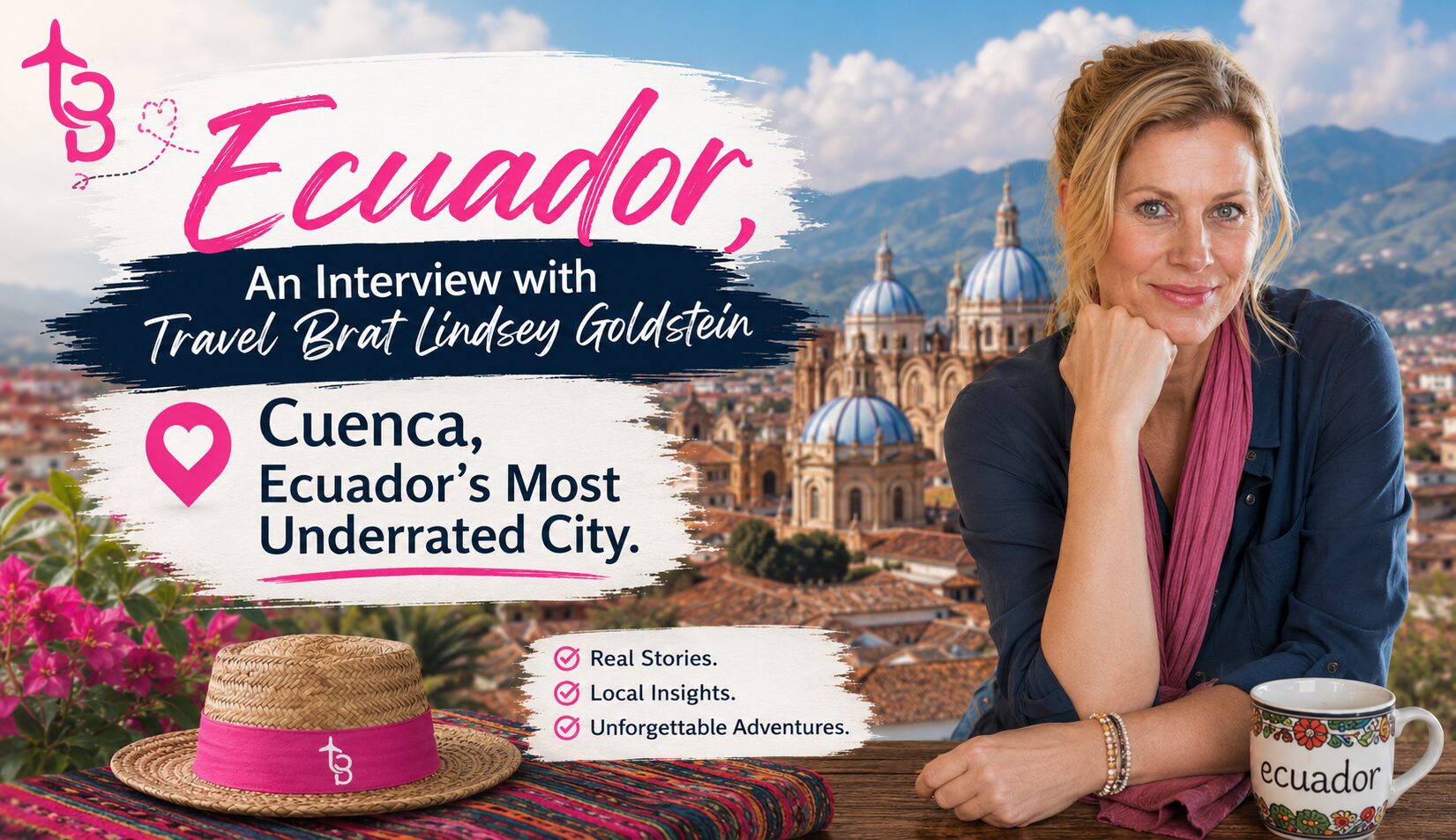
Cuenca, Ecuador’s Most Underrated City.
Ask most travelers about Ecuador, and they’ll mention Quito or the Galápagos.
Ask Lindsey Goldstein, and another city immediately comes to mind.
Cuenca.
Nestled in Ecuador’s southern Andes, Cuenca is often called one of the country’s most beautiful cities—and somehow, it’s still overlooked by many international travelers.
For Lindsey, that’s surprising.
“If there’s one place tourists don’t talk about enough, it’s Cuenca,” she told us.
And after hearing her describe it, we couldn’t agree more.
With its cobblestone streets, flower-filled plazas, colonial architecture, winding rivers, and relaxed pace of life, Cuenca feels like the kind of place where you arrive planning to stay for two days…
…and accidentally stay for two weeks.
Unlike larger cities, Cuenca invites you to slow down.
Spend the morning wandering through artisan markets.
Grab a coffee at a sidewalk café.
Watch locals gather in the plazas.
Explore centuries-old churches and museums.
Cross one of the city’s many picturesque bridges.
There’s no pressure to rush from attraction to attraction.
Instead, Cuenca reminds you why you started traveling in the first place.
To experience a place—not simply check it off a list.
Ecuador Is a Country Best Experienced Slowly
One lesson kept resurfacing throughout our conversation with Lindsey.
Slow travel changes everything.
It’s easy to arrive somewhere with a checklist:
- Visit the famous landmark.
- Take the Instagram photo.
- Try the signature dish.
- Move on to the next city.
But Ecuador rewards travelers who linger.
The longer you stay, the more the country begins to reveal itself.
The barista remembers your coffee order.
The fruit vendor greets you by name.
You begin recognizing the same faces in the neighborhood bakery.
The language becomes a little easier.
The streets become a little more familiar.
Eventually, you’re no longer observing Ecuador.
You’re participating in it.
That, Lindsey believes, is when travel becomes transformational.
Solo Travel in Ecuador: One of the Greatest Confidence Builders
Solo travel can feel intimidating.
Especially when your destination is somewhere you’ve never visited before.
Yet Lindsey credits much of her personal growth to the time she spent navigating Ecuador on her own.
After living with a host family during her gap year, she later returned independently, conducting research while living in a youth hostel in Quito.
Those months taught her lessons that couldn’t be learned inside a classroom.
She learned to trust herself.
She learned to communicate across language barriers.
She learned to solve problems independently.
Most importantly…
She learned that she was capable.
“When you’re traveling alone,” Lindsey explained, “you’re much more open to meeting people.”
Without familiar companions, conversations happen naturally.
You accept invitations.
You ask questions.
You make friends.
Some of those friendships last a lifetime.
In fact, one of Lindsey’s closest friends today is someone she met while staying in that hostel more than twenty years ago.
Travel has a remarkable way of shrinking the world.
Is Ecuador Safe?
It’s one of the first questions travelers ask.
And it’s one Lindsey hears constantly.
During our conversation, she addressed one of the biggest misconceptions Americans have about South America.
“It’s dangerous.”
While every destination has areas that require caution, Lindsey believes Ecuador’s reputation is often exaggerated.
“I actually felt safer in many parts of Ecuador than I have walking around certain cities in the United States.”
Her advice wasn’t to ignore safety.
It was to practice the same common sense you’d use anywhere in the world.
That means:
- Stay aware of your surroundings.
- Avoid isolated areas after dark.
- Leave expensive jewelry at home.
- Keep valuables secure.
- Use registered transportation.
- Learn about neighborhoods before exploring.
- Trust your instincts.
Those are smart travel habits whether you’re in Quito, New York City, London, or Los Angeles.
Fear shouldn’t keep us from experiencing incredible places.
Preparation should replace fear.
Learning Spanish Changed Everything
One of Lindsey’s biggest advantages—and greatest challenges—was learning Spanish.
When she arrived in Ecuador as a teenager, very few people around her spoke English.
She attended a local high school.
If she wanted friends…
She needed Spanish.
If she wanted conversations…
She needed Spanish.
If she wanted to understand Ecuador…
She needed Spanish.
At first, that felt overwhelming.
Eventually, it became one of the most rewarding parts of her experience.
Today, more English is spoken in Ecuador’s tourism industry than when Lindsey first lived there, making travel much easier for visitors.
Still, she encourages every traveler to learn at least a few phrases before arriving.
Simple greetings like:
- Hola
- Buenos días
- Gracias
- Por favor
- ¿Dónde está…?
- ¿Cuánto cuesta?
go a long way.
Not because perfect Spanish is expected.
But because making an effort demonstrates respect.
And respect often opens doors that guidebooks never mention.
Ecuador’s Food Is Comfort Food with a Twist
Every destination tells its story through food.
Ecuador is no exception.
During our interview, Lindsey lit up when we asked about her favorite local dishes.
Without hesitation, she mentioned humitas.
Think of them as Ecuador’s comforting answer to tamales.
Fresh sweet corn is ground into a smooth mixture before being blended with cheese, garlic, and seasonings.
The mixture is wrapped in corn husks and gently steamed.
Served warm with a spoonful of spicy ají sauce, it’s one of those deceptively simple dishes travelers remember long after they return home.
She also loves quimbolitos, a sweeter cousin to the humita, often made with raisins and perfect alongside an afternoon coffee.
Then there’s one of Ecuador’s most beloved street snacks.
Fresh choclo.
Unlike the sweet corn many North Americans are familiar with, Ecuadorian choclo features giant, chewy kernels served with salty local cheese.
It’s sold throughout the country by vendors working from roadside carts and local markets.
Simple.
Authentic.
Delicious.
And exactly the kind of experience travelers miss when they only eat inside tourist restaurants.
Markets Are the Heartbeat of Ecuador
One of our favorite themes from this conversation was Lindsey’s love for local markets.
Markets aren’t just places to shop.
They’re places to observe daily life.
You’ll hear conversations in Spanish and Indigenous languages.
You’ll smell freshly baked bread, roasted corn, herbs, spices, and tropical fruit.
You’ll watch artisans weaving textiles that have been made the same way for generations.
You’ll discover fruits you’ve never seen before.
Lindsey laughed while remembering how she once became obsessed with cherimoya, eating so much that friends eventually warned her she might regret her enthusiasm.
It’s a reminder that travel should engage every sense.
Not just your camera.
Adventure Around Every Corner
Whether you’re an experienced adventurer or someone looking to try something new, Ecuador delivers.
Want to hike?
Climb Cotopaxi or Chimborazo.
Prefer wildlife?
Head into the Amazon or the Galápagos.
Love hot springs?
Visit Baños.
Interested in surfing?
Explore Ecuador’s Pacific coast.
Looking for wildlife photography?
Few countries offer as much biodiversity in such a compact area.
For Lindsey, every region offered something different.
One day she was climbing an active volcano.
Another day she was canoeing through the Amazon.
The next, she was snorkeling beside playful sea lions.
Few destinations make that kind of variety possible.
Listen to the Full Podcast Episode
Want to hear Lindsey’s stories in her own words?
In this episode of The Travel Brats Podcast, you’ll hear even more about:
- How Ecuador changed her life
- The inspiration behind Gap Year
- Why solo travel builds confidence
- Ecuador’s hidden gems
- Quito, Cuenca, the Amazon, and the Galápagos
- Ecuadorian food and culture
- Safety tips for South America
- Why it’s never too late to reinvent yourself
Whether you’re planning your first trip to South America or simply dreaming about what’s next, this conversation is filled with inspiration, practical advice, and unforgettable travel stories.
🎧 Listen here on our website or wherever you get your podcasts, including Spotify and Apple Podcasts.
About Lindsey Goldstein
Lindsey Goldstein is the author of Gap Year, a novel inspired by her own experiences living in Ecuador. Before becoming a novelist, she spent time studying, researching, and living throughout Ecuador, including summers in Quito and the Galápagos Islands. Her writing explores reinvention, travel, identity, motherhood, and the courage to begin again.
Learn more about Lindsey, her book, and her latest projects by visiting her website and following her on social media.
Up Next in Blog 3
In our final blog, we’ll explore the inspiration behind Lindsey’s novel Gap Year, why it’s never too late to reinvent yourself, what travel taught her about resilience, her dream destination after Ecuador, and the biggest life lessons every traveler can bring home. We’ll also wrap up with practical planning tips, our podcast recap, and a call for our Travel Brats readers to start planning their own Ecuador adventure!
Keep reading


In this post
- Cuenca, Ecuador's Most Underrated City.
- Ecuador Is a Country Best Experienced Slowly
- Solo Travel in Ecuador: One of the Greatest Confidence Builders
- Is Ecuador Safe?
- Learning Spanish Changed Everything
- Ecuador's Food Is Comfort Food with a Twist
- Markets Are the Heartbeat of Ecuador
- Adventure Around Every Corner
- Keep reading